Saving links feels productive until you need to use them.
A useful article goes into bookmarks. A quote lands in a note. A tool gets saved for later. Then, when it is time to write, decide, or build, the research is scattered everywhere.
This n8n research collector workflow helps organize saved links, snippets, and rough notes into a practical research brief.
The important move is separating findings from assumptions. That keeps the brief useful without pretending every saved link is verified evidence.
This is Workflow 7 in the GetPrompting Free n8n Workflow Library. It teaches source-aware organization so research turns into something you can act on.
saved links -> source notes -> themes -> research brief -> next actions
Quick Copy
Research Collector Prompt
Use this manually before wiring the full workflow. If the prompt helps by hand, it is worth automating.
You are organizing saved research into a practical brief.

Research topic:
[TOPIC]

Research goal:
[WHAT DECISION OR CONTENT THIS SUPPORTS]

Saved items:
[LINKS, SNIPPETS, AND NOTES]

Source rules:
[HOW TO HANDLE UNVERIFIED CLAIMS]

Return:
- source list
- key findings
- themes
- assumptions
- follow-up questions
- recommended next actions
- tags
- human review note
What the Research Collector Does
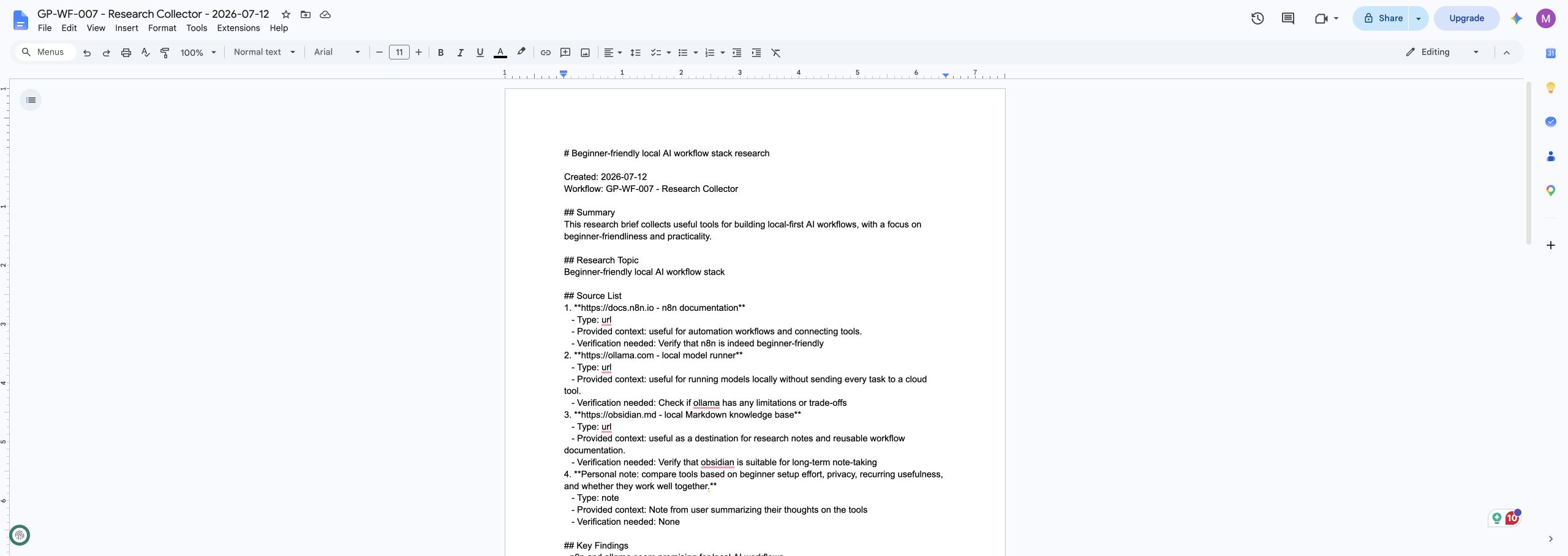
The workflow takes research topic, research goal, target audience, saved items, source-handling rules, and knowledge-base destination and turns them into a Google Doc with sources, themes, findings, assumptions, follow-up questions, next actions, and tags.
The important part is not that the workflow is complicated. It is that the workflow creates a real document you can review, edit, and use. That is what separates a practical automation from a fun demo.
Why This Workflow Matters
This workflow teaches source-aware organization. The goal is not just summarizing notes. It is turning scattered research into a brief with findings, assumptions, follow-up questions, and next actions.
If the saved research is coming from competitor pages, feeds, or search snapshots, this competitor tracking workflow guide shows how to separate source evidence from AI-assisted interpretation.
This matters because beginners often try to automate the exciting part first. They jump straight to agents, dashboards, and complicated branching logic before the core pattern is reliable. I like starting smaller. Make one useful thing work. Then make it better.
That approach is slower for about five minutes and faster for everything after that. Once the base workflow is understandable, you can change the model, destination, trigger, or output format without rebuilding from scratch.
What You Need Before You Build It
The version I built uses n8n, Ollama, a local chat model, and Google Docs. You can change those pieces later, but this setup makes the workflow easy to inspect and test.
- n8n running locally, self-hosted, or in n8n Cloud
- Ollama running locally if you want the local AI version
- a local chat model such as
llama3.1:8b, or another model your machine runs reliably - a Google account
- Google Docs credentials connected inside n8n
Download the Free n8n Workflow
I published the clean workflow export on GitHub so you can import it, inspect it, and adapt it to your own setup.
Download the Research Collector workflow on GitHub
The repo includes the n8n workflow JSON, screenshots, sample input, sample output, installation notes, customization ideas, and troubleshooting docs.
The public export does not include my private credentials, OAuth tokens, workflow IDs, API keys, or account details. After importing it, you will still need to connect your own Google Docs credential inside n8n.
How This n8n Research Collector Workflow Works
Here is the practical flow:
Manual Start -> Set Workflow Inputs -> Build AI Prompt -> Generate With AI -> Review AI Output -> Prepare Google Doc -> Create and Write the Google Doc
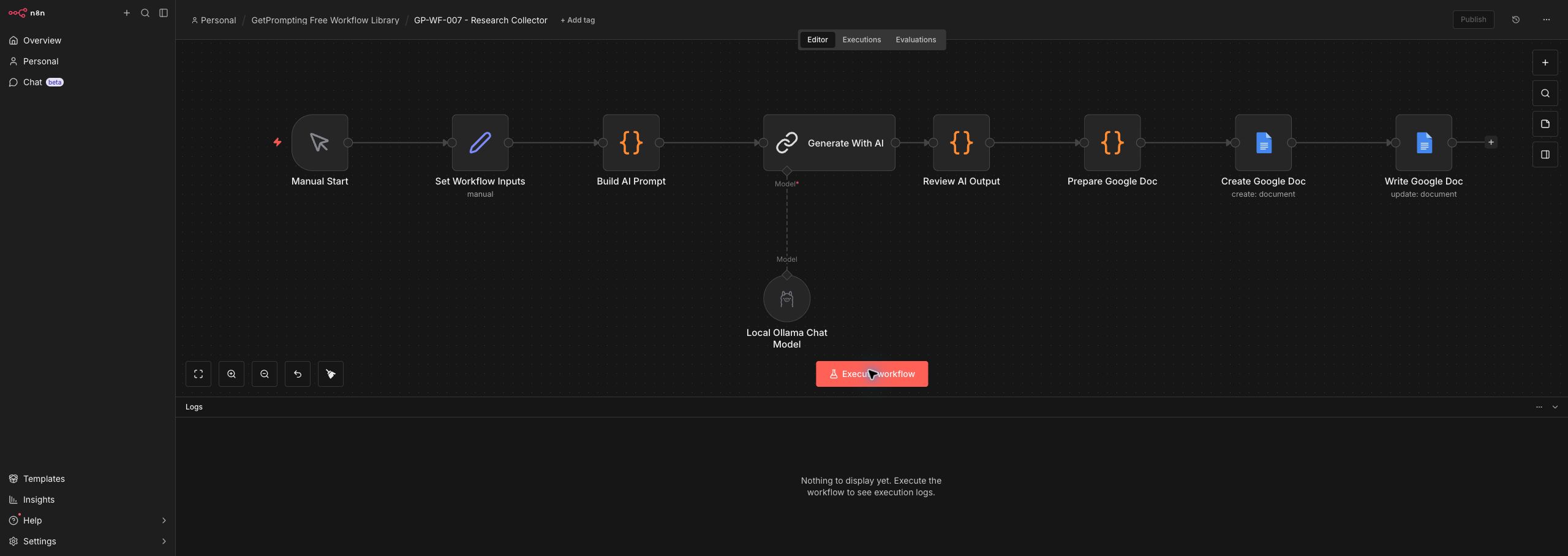
Let us walk through the main pieces.
1. Manual Start
Manual execution keeps the first version simple while you learn what kind of saved items create useful briefs.
2. Set Workflow Inputs
This node stores the topic, goal, audience, saved items, source rules, and destination notes.
3. Build AI Prompt
The prompt asks the model to separate findings, assumptions, and follow-up questions. That keeps the brief honest.
4. Generate With AI
The local model organizes the saved material into a research brief.
5. Review AI Output
The review step formats the brief and keeps source-handling notes visible.
6. Prepare Google Doc
This node turns the organized research into a document you can review before using it.
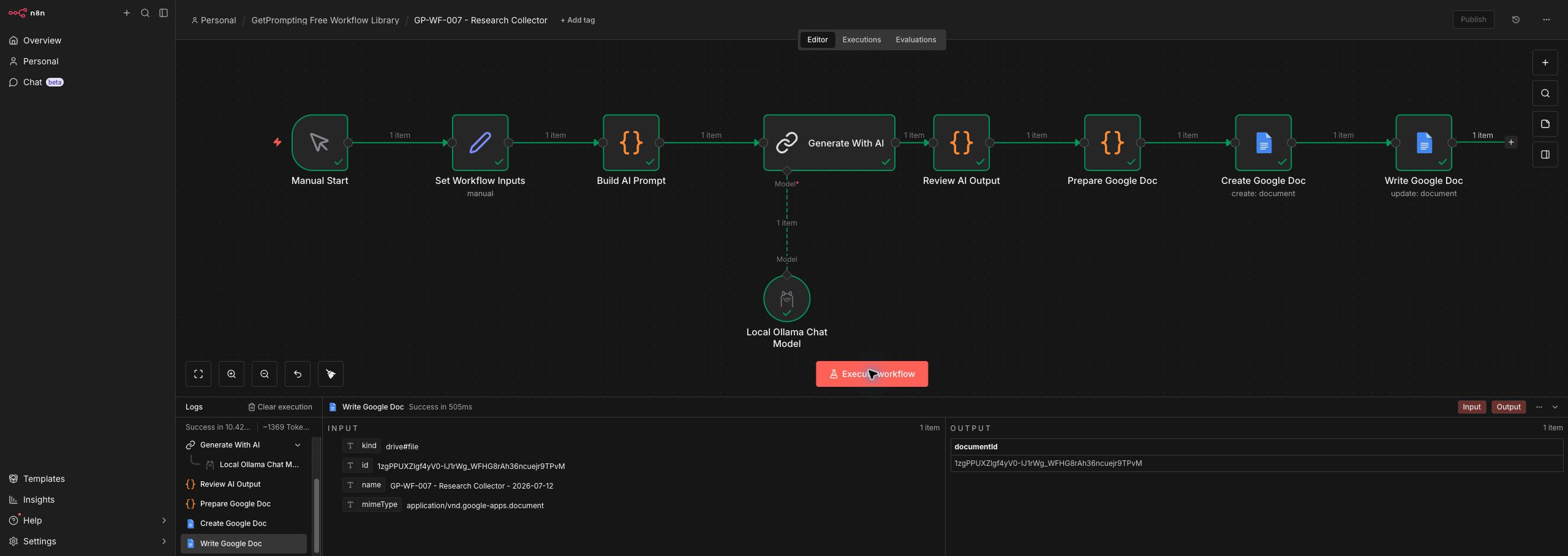
7. Create and Write the Google Doc
The final document becomes a research asset for articles, decisions, or project planning.
The New Concept This Workflow Teaches
This workflow teaches source-aware organization. The goal is not just summarizing notes. It is turning scattered research into a brief with findings, assumptions, follow-up questions, and next actions.
If the saved research is coming from competitor pages, feeds, or search snapshots, this competitor tracking workflow guide shows how to separate source evidence from AI-assisted interpretation.
That concept is the reason this article exists as its own piece instead of being a copy of the previous workflow guide. Each workflow in the library should add a useful idea you can carry into future builds.
Once you understand this pattern, you can reuse it in other workflows. The exact topic changes, but the habit stays the same: define the input, give the model a clear job, review the output, and send the result somewhere useful.
How to Customize This Workflow
The GitHub version is intentionally simple. That is a feature, not a limitation. A simple workflow is easier to understand, modify, and trust.
Change the Inputs
Open the Set Workflow Inputs node and replace the sample values with your own research topic, research goal, target audience, saved items, source-handling rules, and knowledge-base destination. If you use this often, you can replace the manual fields with a form, webhook, Google Sheet row, Obsidian note, or Notion database item.
Change the Model
The default version uses a local Ollama model. Smaller models are usually faster and cheaper to experiment with. Larger models may follow complex instructions better, but they can be slower and more memory hungry.
You can also swap the local model for a cloud model through n8n if the workflow needs stronger reasoning. I would still keep the review step, because better models are not the same thing as perfect models.
Change the Output Destination
Google Docs is a friendly first destination because it is easy to read and edit. But you can point the same pattern to Obsidian, Notion, Airtable, Google Sheets, a local Markdown file, a task manager, or a custom dashboard.
Upgrade It Later
- Add automatic page extraction for URLs.
- Write approved notes to Obsidian.
- Add source credibility fields.
- Create separate briefs for content, product, and technical research.
Common Mistakes to Avoid
Treating saved links as verified evidence
Saved does not mean true. Important claims still need review.
Mixing research goals
A buying decision, article brief, and technical build note need different research shapes.
Saving everything forever
A good research workflow should also help you park weak items instead of hoarding them.
Where This Fits in a Bigger AI Workflow System
The Research Collector is small on purpose, but it fits into a larger practical workflow system. It can sit beside the Daily Action Brief Builder, the Search Intent Blog Outline Builder, and the rest of the free n8n workflow library as one reusable tool in a larger process.
That is the real value of building these workflows one at a time. You are not just collecting templates. You are learning patterns: cleanup, planning, triage, structure, review, repurposing, documentation, and knowledge management.
Those patterns compound. A small workflow that solves one clear problem today can become a building block for a much more useful system later.
Where this fits: research collection is one of the cleanest places to practice AI workflow thinking because the input, summary, review, and saved output are easy to see.
Final Thoughts
The Research Collector is not impressive because it is massive. It is useful because it gives one messy problem a clear path from input to output.
That is the kind of automation worth learning. It respects the human part of the work while using AI to handle the structure, cleanup, and first-pass organization.
If you want to experiment with it, download the free workflow from GitHub, import it into n8n, run the sample input once, and then replace the sample with something from your own work.
Start small. Make it useful. Then improve one piece at a time.
Stay sharp,
Michael
Creator of GetPrompting.com
Keep Building the Workflow Library
This guide is part of the Free n8n Workflow Library, a set of small n8n builds designed to be imported, inspected, and customized one workflow at a time. If you want the previous step in the series, read SOP Generator. The next build is Social Post Generator, which adds another practical pattern without turning the system into one giant automation.
Next step
Ready to adapt this workflow?
Use the guide as a reference build, then decide whether to test it yourself or map the safer version for your own stack.
Open the GitHub repository, inspect the workflow export, and test one change at a time before trusting it with real work.
Open GitHub repoIf this needs to fit your CRM, content process, reporting setup, or local tools, a focused review can surface weak spots before you rebuild.
Ask Michael to review it